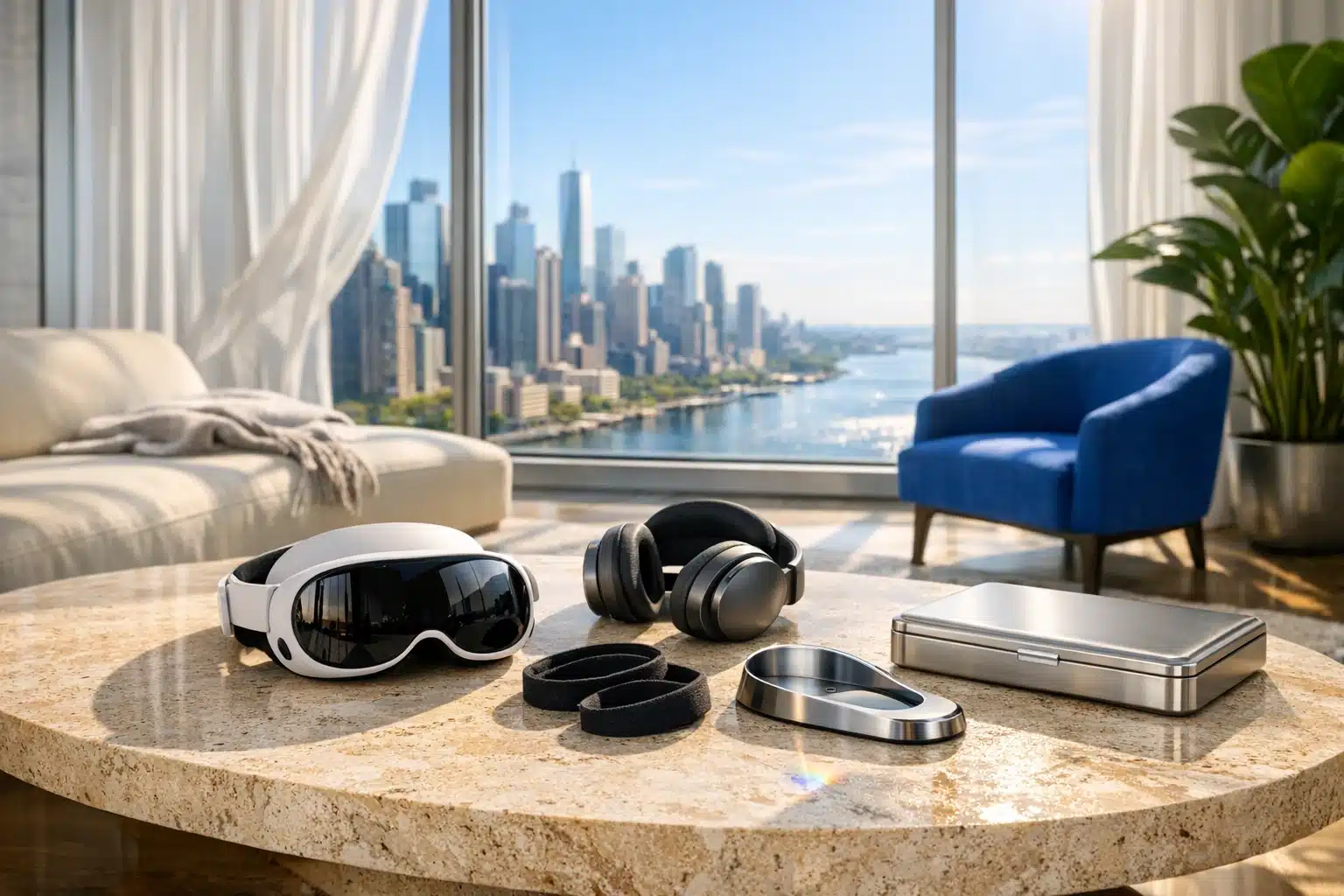
 Artificially generated image
 Top Hyper-Realistic VR Intimacy Tech People Are Exploring
VR intimacy technology sits at the crossroads of consumer electronics, sensory design, and changing social habits. What once looked like science fiction now includes advanced headsets, haptic accessories, responsive audio, and software built to create a stronger sense of presence. As immersive VR technology improves, people are asking sharper questions about realism, privacy, compatibility, and ethics. That makes this topic relevant not just to early adopters, but to anyone tracking how digital experiences are becoming more personal.
Outline
This article moves from definition to practical evaluation, starting with the core meaning of hyper-realistic experiences, then examining the hardware stack, the design methods that create presence, the trends shaping the industry, and finally the questions users and creators should ask before investing time or money.
- An overview of hyper-realistic VR intimacy technology, covering features, hardware compatibility, design innovations, and industry trends.
- Key differences between basic VR content and more advanced intimacy-focused systems.
- The role of headsets, haptics, tracking, software standards, privacy tools, and user expectations.
- A grounded conclusion for curious readers, buyers, developers, and observers of immersive media.
What Hyper-Realistic VR Intimacy Tech Actually Means
When people talk about hyper-realistic VR intimacy tech, they are usually describing a combination of hardware and software designed to make remote, simulated, or guided experiences feel more immediate, responsive, and emotionally convincing. The phrase sounds futuristic, but its building blocks are familiar: high-resolution displays, low-latency motion tracking, spatial audio, hand interaction, responsive haptics, and software that reacts in real time. The difference is not one dramatic invention. It is the stacking of many small improvements until the gap between “watching” and “feeling present” becomes much narrower.
Older digital intimacy experiences were mostly flat-screen, passive, and limited by keyboard, touchscreen, or video chat interfaces. VR intimacy technology changes that equation by turning the user from an observer into a participant inside a 3D environment. Presence matters here. If a headset tracks subtle head movement, if audio seems to come from a believable position in space, and if touch feedback arrives with minimal delay, the brain begins to treat the scene less like media and more like an event. That does not mean the illusion is perfect, but it does explain why this category is attracting attention from both consumers and developers.
Hyper-realism in this context usually depends on several pillars:
- Visual fidelity, including resolution, frame rate, contrast, and depth cues
- Natural interaction through controllers, hand tracking, or body tracking
- Responsive feedback from haptic devices or connected accessories
- Believable avatar movement, facial expression, and timing
- Privacy and personalization features that let users control the experience
There is also a social dimension. Some people explore these tools out of curiosity, some for long-distance connection, some because immersive environments feel less awkward than traditional interfaces, and others because they are interested in adult wellness technology as a wider category. Not every product is built for the same purpose. One platform may focus on companionship and conversation, while another leans into synchronized haptics or creator-driven virtual scenes. That range matters, because “VR intimacy” is not a single product class so much as a broad ecosystem.
A useful comparison is the evolution from early mobile photography to modern smartphone cameras. At first, the novelty was enough. Later, users began expecting image stabilization, night mode, portrait depth, and editing tools. Something similar is happening here. People are moving past novelty and asking better questions: Does it work smoothly across devices? Is the motion believable? Can users set boundaries? Does the software protect data? Those are signs of a maturing segment. In other words, the most interesting part of immersive VR technology is no longer that it exists. It is that it is becoming detailed enough to evaluate seriously.
The Hardware Stack: Headsets, Haptics, and Compatibility
Behind every convincing VR intimacy technology setup is a hardware chain that has to work in sync. Headsets remain the center of that chain, because display clarity, tracking stability, and comfort determine whether a user stays engaged or starts noticing friction. Standalone systems such as the Meta Quest line are popular because they reduce setup complexity, while PC VR options can deliver stronger graphics, broader mod support, and higher-end customization. PlayStation VR2 adds another angle by showing how console ecosystems can bring premium features, such as eye tracking and advanced controllers, into a more standardized environment.
Compatibility is one of the least glamorous topics in immersive VR technology, but it often decides whether an experience feels polished or frustrating. A user may have a capable headset, but the full system still depends on app support, tracking quality, connection methods, and whether external accessories are recognized correctly. Many intimacy-focused devices rely on Bluetooth, USB, Wi-Fi, or bridge software to synchronize haptics with media or live interaction. Even small timing problems can break immersion. A delay that barely matters in a casual video becomes far more noticeable when the product promises responsive realism.
Several technical factors shape the user experience:
- Refresh rate and frame pacing, which affect comfort and motion clarity
- Tracking method, including inside-out tracking, external base stations, or hand tracking
- Connection type, such as wired PC VR, wireless streaming, or native standalone apps
- Software standards like OpenXR, which can improve cross-platform support
- Accessory ecosystems, including haptic wearables and adult wellness hardware
Design compatibility is just as important as raw specifications. A heavier headset may deliver strong visuals but become tiring during longer sessions. A powerful haptic device may offer richer feedback but require multiple apps, firmware updates, or account links. Users quickly learn that realism is not created by one premium component. It comes from smooth cooperation across the full stack. In the best systems, setup fades into the background and the technology becomes almost invisible.
There are also practical limits. Battery life matters on standalone devices. Wireless streaming can introduce compression artifacts or latency. Face cushions affect hygiene and comfort. Audio choices change the sense of intimacy more than many buyers expect; spatial sound through quality headphones often does more for immersion than a small jump in screen resolution. Some users prefer open social platforms, while others want private local experiences with minimal data sharing. The hardware conversation, then, is not just about performance. It is about matching the setup to the person, the use case, and the level of technical patience available. For curious buyers, that may be the most important comparison of all.
Design Innovations That Make Virtual Presence Feel More Convincing
If hardware provides the stage, design is what teaches the performance to breathe. The most significant advances in hyper-realistic VR intimacy tech are not always visible in a screenshot. They emerge through timing, animation, interaction logic, and sensory layering. A scene can look impressive in still images and still feel lifeless if characters move unnaturally, if eye contact breaks at the wrong moment, or if the environment reacts too slowly. That is why leading developers spend so much effort on the invisible craft of presence.
One major innovation is better avatar behavior. Realistic body movement depends on inverse kinematics, motion capture data, and animation blending that can adapt to user position in real time. The goal is not necessarily perfect realism, because hyper-accurate human simulation can drift into the uncanny valley. Instead, many designers aim for credibility: motion that feels responsive, expressions that read clearly, and interactions that maintain emotional continuity. A slight head tilt, a believable pause, or a synchronized glance can add more to the feeling of connection than another layer of visual polish.
Spatial audio is another quiet powerhouse. In immersive VR technology, sound tells the brain where things are and how close they feel. Binaural rendering, room acoustics, and dynamic voice positioning can create a stronger sense of nearness, warmth, and realism. It is the digital equivalent of lighting a room properly before inviting anyone inside. The details disappear, but the mood changes completely.
Current design trends also include:
- Eye tracking and face tracking for more natural social feedback
- Hand tracking that removes the barrier of controllers in some scenarios
- Adaptive haptic scripting that responds to media, motion, or live input
- AI-assisted dialogue systems that support more fluid interaction
- Accessibility settings for intensity, pacing, seated play, and comfort
Still, innovation brings responsibilities. Systems that learn user preferences or record interaction patterns must be designed with care. Biometric data, gaze direction, voice recordings, and usage history can reveal deeply personal information. Good design is therefore not only about sensation. It is also about restraint. Clear consent prompts, local data options, visible control panels, and easy pause or exit features are part of the experience architecture.
There is a poetic side to this field as well. Developers are trying to build moments that feel less like menus and more like places. The interface recedes, the environment softens, and the user is not merely clicking through a program but inhabiting a small pocket of crafted reality. That creative ambition helps explain the fascination around VR intimacy technology. It sits at a rare intersection where engineering, psychology, animation, and sound design all have to move in rhythm. When they do, even briefly, the result can feel surprisingly human.
Industry Trends: From Niche Curiosity to a More Structured Market
The industry around VR intimacy technology is still fragmented, but it is clearly growing more organized. A few years ago, many products in this space felt experimental, isolated, or difficult to use outside enthusiast communities. Today, the broader rise of immersive VR technology is creating more stable tools, better engines, and clearer expectations for both creators and users. Advances made for gaming, fitness, social VR, and enterprise training often spill into intimacy-focused applications. Better passthrough, improved eye tracking, lighter headsets, and more mature development platforms benefit the entire ecosystem, even when they were not designed for that purpose.
One trend worth watching is standardization. Developers increasingly build around shared frameworks instead of making every experience for one headset only. OpenXR has become part of that conversation by helping software run across multiple devices with less duplication. This does not solve every compatibility problem, but it reduces friction. Another major trend is connected hardware. Haptic companies are trying to make their products easier to pair, control, and update, because consumers have become less tolerant of clumsy setup. In practical terms, convenience is becoming a competitive feature.
The market is also being shaped by several pressures at once:
- Privacy regulation and rising concern about sensitive behavioral data
- Platform moderation rules, age-gating, and payment processing limits
- Demand for creator tools that support customization and safer interaction
- Growth in long-distance social experiences and digital companionship models
- A wider consumer understanding of wellness technology and haptics
Privacy is probably the issue that will define trust in this category. Intimacy-related platforms handle especially sensitive information, including device pairings, usage patterns, account histories, and sometimes voice or biometric signals. A weak privacy design can damage user confidence faster than any flashy feature can rebuild it. That is why encryption, transparent data policies, optional local control, and meaningful consent settings are no longer bonus features. They are baseline expectations for responsible companies.
Another trend is the blending of categories. The line between social VR, relationship apps, adult wellness devices, and AI-powered companionship tools is becoming less distinct. Some products present themselves as entertainment. Others emphasize communication, personalization, or emotional support. The result is a market that resists simple labels. This can be exciting, but it also makes evaluation harder. Buyers should read claims carefully, because polished branding sometimes hides limited functionality.
In a broader sense, the industry is moving from spectacle to infrastructure. The most durable companies may not be the ones with the loudest launch videos, but the ones building dependable software layers, secure syncing, thoughtful onboarding, and cross-device support. That is often how technology matures: not with one dramatic leap, but with quieter improvements that make the whole experience more usable.
What Curious Users and Creators Should Consider Next
For readers exploring this topic, the smartest approach is neither blind enthusiasm nor automatic dismissal. Hyper-realistic VR intimacy tech is best understood as a developing toolkit. Some parts are already impressive. Others remain awkward, expensive, or inconsistent. The difference between a memorable experience and a disappointing one often comes down to expectations. People who approach the space as a polished, universal solution may be frustrated. Those who see it as an emerging category of immersive media and connected hardware will usually evaluate it more clearly.
If you are a user, start with fundamentals before chasing premium features. Ask whether the headset is comfortable for extended use, whether the platform has a reliable privacy policy, and whether the accessory ecosystem is actually compatible with your setup. Read beyond promotional pages. Search for notes about firmware stability, wireless reliability, account requirements, and customer support. In intimacy-focused technology, trust is part of the product. A device can be technically advanced and still feel poorly designed if the app is confusing or the data policy is vague.
A practical checklist can help:
- Confirm headset and operating system compatibility before buying add-ons
- Check whether software requires subscriptions, bridge apps, or cloud accounts
- Review privacy controls for recordings, usage data, and device permissions
- Look for comfort options such as seated modes, pacing controls, and quick exits
- Consider hygiene, storage, updates, and long-term support, not just launch features
If you are a creator or developer, the message is equally clear. Realism alone is not enough. Users remember whether a system felt safe, intuitive, and respectful. Clear onboarding, adjustable intensity, accessibility tools, and transparent consent design can matter more than cinematic visuals. In many ways, immersive VR technology is entering the same maturity test faced by social media, mobile apps, and wearable tech before it: can the experience scale without eroding trust?
There is also room for creativity. The future of VR intimacy technology may not be defined only by more lifelike simulation. It may also be shaped by better emotional design, more inclusive avatar systems, stronger long-distance interaction tools, and interfaces that feel calmer and less mechanical. Sometimes the next breakthrough is not a louder effect but a quieter one, like a smoother connection flow or a more believable pause in conversation.
For the target audience of this topic, the takeaway is simple. Whether you are a buyer, a researcher, a developer, or just an observant reader, this field deserves measured attention. It combines real technical progress with real ethical questions. The people who benefit most will be those who compare carefully, protect their data, choose compatible tools, and understand that meaningful immersion comes from thoughtful design rather than hype alone.