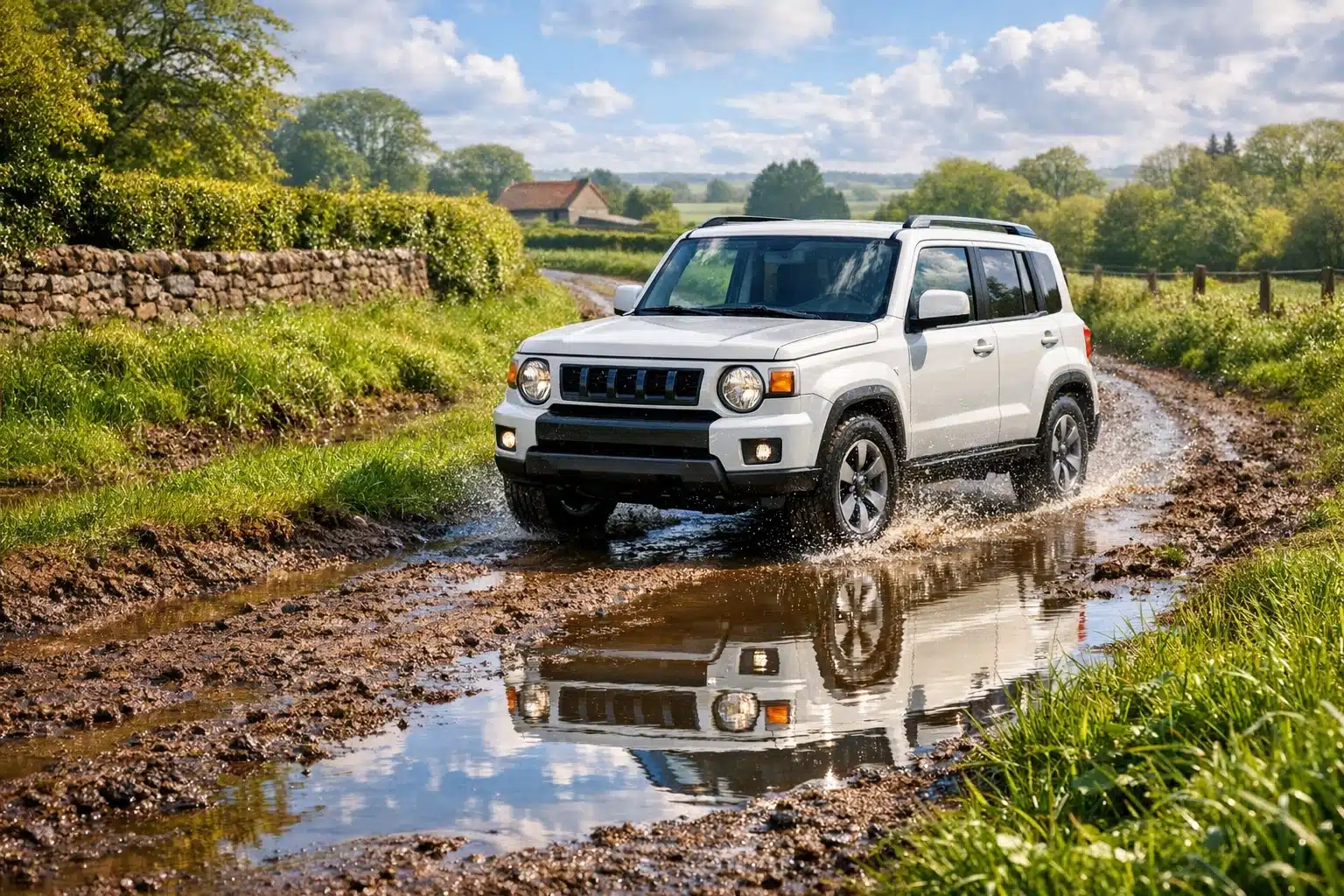
 Artificially generated image
 Benefits of Compact 4×4— Efficiency, maneuverability & rugged capability
When a country lane turns to soup, a gravel track starts skating under the tires, or fresh snow erases the lane markings, a compact 4×4 earns its keep in seconds. These systems give drivers extra traction without the mass, cost, or parking stress that often comes with a full-size off-roader. Knowing how they respond on different surfaces makes it easier to drive well and choose the right tires, modes, and habits. The sections below sketch the route first and then dig into the mechanics, compromises, and real-world behavior.
Outline: this article first explains how compact 4×4 systems are built and why they differ from larger truck-based setups. It then examines mud, gravel, and snow one by one, showing how traction, wheel control, tire design, and driver technique change from surface to surface. The final section brings everything together with practical guidance for owners, buyers, and anyone deciding whether a compact 4×4 fits everyday life.
How compact 4×4 systems are designed to balance efficiency and capability
Compact 4×4 systems live in an interesting engineering space. They are expected to feel easy in traffic, return sensible fuel economy, remain comfortable on long commutes, and still cope when pavement gives way to slick clay, loose stone, or winter slush. To make that combination possible, most modern compact systems rely on electronic control, fast-reacting clutch packs, wheel-speed sensors, and carefully tuned stability software rather than the heavy-duty transfer cases and solid axles found in larger off-road vehicles. That does not make them weak; it makes them specialized.
In many compact crossovers and smaller SUVs, the drivetrain runs in a front-biased layout during steady cruising. When the vehicle senses slip, steering angle changes, or sudden throttle input, a center coupling or rear clutch pack can send part of the torque to the rear axle. Some systems wait for wheelspin, while better calibrated ones predict it. That predictive behavior matters because traction lost is harder to recover than traction managed early. On dry roads, the benefit is efficiency. On slippery surfaces, the benefit is speed of response.
Key building blocks usually include:
– an electronically controlled coupling that varies front-to-rear torque flow
– open axle differentials supported by brake-based traction control
– selectable drive modes that alter throttle mapping, shift behavior, and stability thresholds
– modest but useful ground clearance, often around the level needed for rutted lanes and snowy roads rather than boulder crawling
For many buyers, the attraction is practical rather than theatrical. Search behavior reflects the same idea, as more drivers Explore compact 4×4 driving solutions — affordable, efficient systems designed for off‑road capability, urban maneuverability, and everyday reliabilit when one vehicle must handle school runs, wet fields, and winter weekends alike. The phrase may sound promotional, but the underlying logic is real: compact systems are not trying to out-climb dedicated rock crawlers. They are trying to do many jobs well enough that owners can live with them every day.
The trade-off is equally important to understand. A compact 4×4 can distribute torque, trim wheelspin, and improve stability, but it cannot create grip where the tire compound and surface offer almost none. Tires, weight transfer, and driver input still decide the outcome. Think of the drivetrain as a sharp orchestra conductor: it can organize the players brilliantly, but it cannot perform without instruments.
How compact 4×4 systems manage mud
Mud is one of the most deceptive surfaces a compact 4×4 will meet. At first glance it looks like a simple low-grip problem, yet mud combines slipperiness, suction, depth, and rolling resistance in ways that test every part of the vehicle. One patch may be a thin skim over firm ground, while the next behaves like wet cement around the tread blocks. That is why mud rewards measured momentum more than brute force. Too little speed, and the vehicle sinks into the resistance. Too much speed, and the tires spin, polish the surface, and dig downward.
A compact 4×4 manages mud through three main tools: torque distribution, wheel-slip control, and ground clearance. When the front tires begin to smear rather than bite, the drivetrain can send more drive to the rear axle, helping the vehicle keep moving instead of plowing straight ahead. Brake-based traction control can then slow a freely spinning wheel so torque reaches the wheel with at least some purchase. On systems with a dedicated mud or off-road mode, software often allows slightly more wheelspin before intervening. That matters because a small amount of slip can help the tread clear itself, while harsh intervention can kill forward motion.
Tire design plays a huge role. Road-focused tires tend to pack with mud because their grooves are narrower and their tread blocks are closer together. All-terrain tires, by contrast, usually have wider voids and stronger shoulders that shed material more effectively. In simple terms, a self-cleaning tread keeps finding new edges to grip with. Without those edges, even an excellent drivetrain starts working with dull tools.
Compact vehicles also benefit from being lighter than many traditional 4x4s. Less mass can mean less sink-in on soft ground, especially on moderately muddy tracks. Still, lighter weight is not a magic pass. If the vehicle runs out of clearance, the underbody can drag, the tires lose loading, and momentum disappears. That is why good mud technique often looks calm rather than dramatic:
– keep a steady throttle instead of stabbing the accelerator
– choose the straightest line with the firmest base
– avoid deep ruts unless you know the vehicle’s clearance
– let the system work before adding more power
If the mud becomes axle-deep, long, or heavily rutted, compact systems reach their limits quickly. They are excellent at maintaining progress in shallow to moderate mud, farm tracks, and wet construction approaches, but they are not substitutes for locking differentials, aggressive recovery points, or very large tires. Mud is the surface that most clearly exposes the gap between “capable” and “specialized.”
How compact 4×4 systems stay stable on gravel
Gravel asks different questions than mud. Instead of suction and depth, the challenge is movement under the tire. Loose stones behave like tiny ball bearings over a harder base, so a vehicle can feel planted one moment and slightly afloat the next. On this surface, a compact 4×4 does not simply need grip; it needs composure. The best systems help the driver build confidence by smoothing torque delivery, controlling yaw, and keeping steering responses tidy rather than nervous.
One reason compact 4x4s can work so well on gravel is their size. A shorter wheelbase and lower overall mass often make them easier to place accurately on narrow roads. That matters because gravel rewards line choice. Hugging the cleanest track, avoiding thick piles of loose stone, and setting the car early before a bend all reduce the burden on the drivetrain. The system’s job becomes support, not rescue.
Torque management is especially important here. If too much power arrives too suddenly, the tires skim across the loose top layer and the vehicle may push wide in a corner. Better calibrated systems feed torque progressively, letting the tires dig into the firmer material underneath. Brake-based torque vectoring can also help by trimming the speed of an inside wheel, which encourages the car to rotate more naturally. That does not turn a crossover into a rally car, but it can make the chassis feel far less clumsy.
Braking on gravel introduces another layer. Anti-lock braking systems maintain steering control, which is critical, but on deep loose gravel they may lengthen stopping distances compared with a perfectly judged threshold stop on a sealed road. For everyday drivers, that means space matters more than heroics. The safer strategy is simple:
– increase following distance
– brake earlier and more gently
– keep steering inputs smooth
– avoid abrupt lifts or stabs at the throttle mid-corner
Suspension tuning matters, too. A good compact 4×4 on gravel is not one that feels stiff and dramatic. It is one that allows the wheels to follow ripples and washboard surfaces without bouncing the body into repeated corrections. Good damping keeps the tires in contact with the surface longer, which gives the traction system real work to do. In that sense, gravel reveals the harmony of the whole vehicle. Tires, suspension, software, and steering must all speak in the same calm voice, even when the road crackles under them like poured cereal.
How compact 4×4 systems handle snow and low-temperature traction
Snow is often grouped with other slippery surfaces, but it deserves its own category because temperature, surface type, and compaction change the rules constantly. Fresh powder, wet snow, packed snow, and ice can exist on the same route within a few kilometers. A compact 4×4 manages this shifting puzzle by distributing torque quickly, moderating wheelspin, and supporting the driver during acceleration and direction changes. Yet the most important truth remains wonderfully stubborn: tires matter more than the badge on the tailgate.
On packed snow, available grip can fall to a fraction of what drivers enjoy on dry asphalt, and on ice it drops further still. That is why winter tires are transformative. Their rubber stays more flexible in cold weather, and their tread patterns create biting edges that can interlock with the surface. Give a capable compact 4×4 the wrong tires and it becomes overconfident but underprepared. Give it proper winter tires and its electronics suddenly have something to work with.
The system’s strongest advantage in snow usually appears during starts and climbs. A front-wheel-drive vehicle may spin its loaded front tires when pulling away uphill, while a compact 4×4 can share torque with the rear axle and reduce the scramble. Stability control then manages side-to-side slip if the vehicle begins to yaw. Many systems also offer snow modes that soften throttle response and encourage earlier upshifts, preventing the kind of sharp torque spike that breaks traction. The result feels less exciting than a dramatic launch, but that is precisely the point.
Snow also teaches a lesson that many drivers learn only once: all-wheel drive helps you go, but it does not help you stop as much as people assume. Braking still depends largely on tire grip and weight transfer, not on how many wheels are powered. Sensible snow technique therefore includes:
– longer gaps to the vehicle ahead
– much earlier braking points
– gentle steering inputs
– patient throttle use when leaving junctions or climbing ramps
Ground clearance matters when snow becomes deep enough to drag under the body, and traction aids can help when one side of the car crosses polished tracks while the other runs on loose powder. Still, when conditions become severe, chains where legal, reduced speed, and route choice are often more valuable than any dashboard mode. Snow is quiet, bright, and beautiful, but it is also an honest examiner. It exposes every lazy assumption a driver brings into winter.
Conclusion for everyday drivers and weekend explorers
For the audience most likely to shop this category, the case for a compact 4×4 is straightforward. It offers a meaningful step up in all-season usability without demanding the size, fuel use, or ownership compromises of a heavier off-road machine. That makes it attractive to commuters in cold climates, families who reach cottages or camps by unpaved roads, and drivers whose work takes them onto farm lanes, building sites, or steep rural approaches. The real value is not extreme adventure. It is dependable flexibility.
The smartest buying decision begins with honesty about terrain. If the hardest challenge is occasional mud, regular gravel travel, and a few snowy months, a well-calibrated compact 4×4 with the right tires can be an excellent fit. If the plan involves deep ruts, large rocks, repeated towing, or remote recovery situations, a larger and more purpose-built vehicle may still be the wiser choice. Capability is always contextual.
Owners can get more from these systems by focusing on fundamentals rather than gadgets alone:
– fit tires that match the climate and surface
– keep tread depth healthy, because worn tires blunt every electronic aid
– maintain alignment and suspension components so the vehicle tracks cleanly
– learn what each drive mode actually changes before bad weather arrives
– carry simple recovery gear suited to legal and safe use, such as a shovel, gloves, and traction boards where appropriate
What ties mud, gravel, and snow together is not just traction. It is the way compact 4×4 systems help the vehicle stay manageable when the surface becomes uncertain. In mud, they preserve forward motion through controlled slip and better torque sharing. On gravel, they calm the chassis and make loose surfaces less tiring. In snow, they improve starts, climbs, and directional stability, especially when paired with proper winter tires. None of those gains remove the need for judgment, but they do widen the margin for ordinary drivers facing extraordinary road conditions.
If you want a vehicle that threads through city streets during the week and copes with messy routes on the weekend, this class makes a strong argument for itself. Compact 4x4s are at their best when used with realistic expectations, sound maintenance, and thoughtful driving. Treat them as capable partners rather than miracle machines, and they usually return the favor with calm, useful competence all year long.