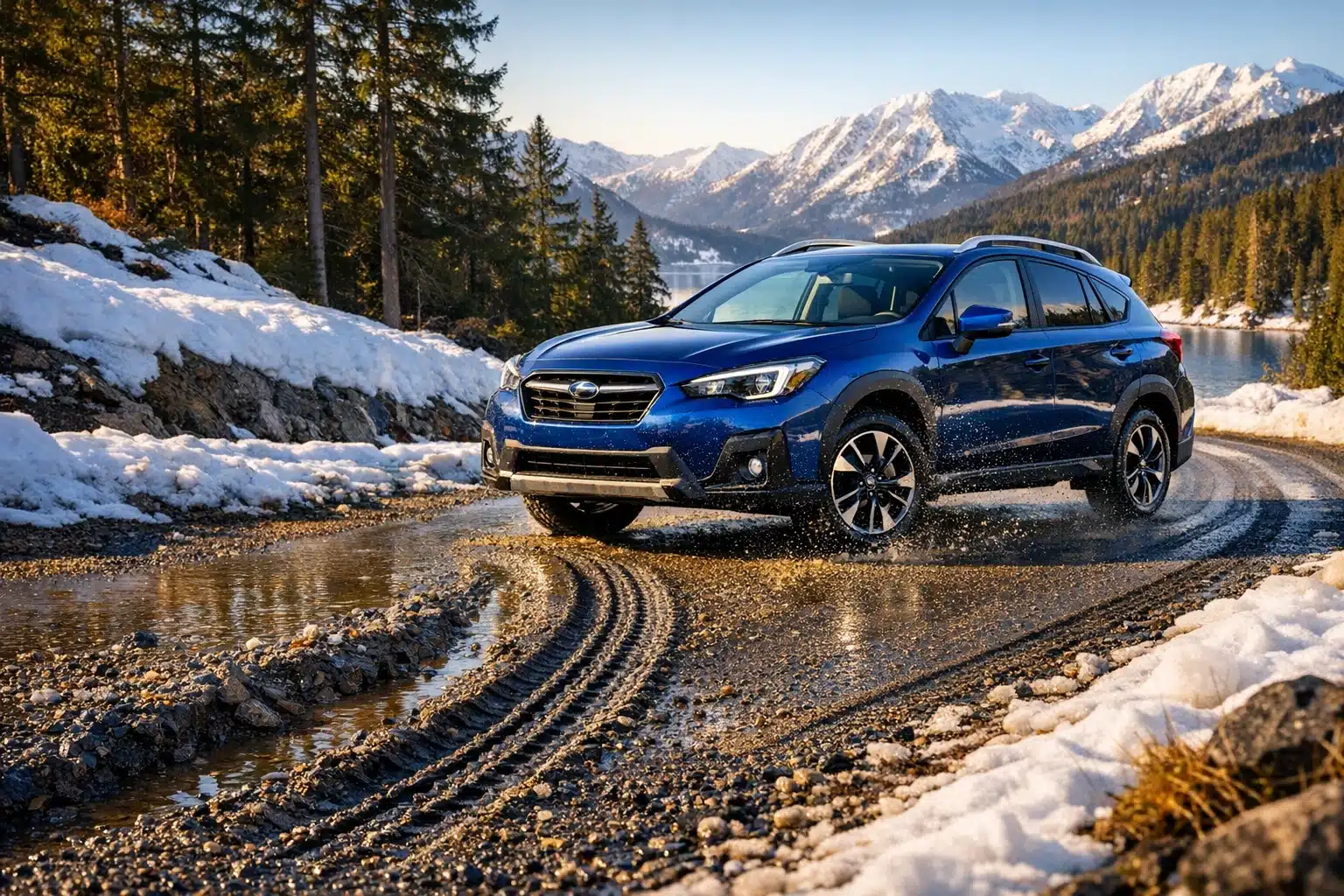
 Artificially generated image
 Benefits of Compact 4×4— Efficiency, maneuverability & rugged capability
Compact 4×4 systems matter because many drivers need one vehicle that can slip through city streets on Monday, face a muddy campsite on Saturday, and stay composed when winter settles in. Their appeal is not raw muscle alone, but a careful mix of traction, size, fuel use, and purchase cost. As small SUVs and crossovers evolve, these drivetrains are becoming smarter without becoming clumsy. Knowing how they work makes it easier to separate useful engineering from shiny marketing.
This article follows a clear path before diving into detail:
- How compact 4×4 layouts differ from larger truck-based systems
- What really happens when a vehicle enters deep or sticky mud
- Why gravel demands stability, precision, and careful torque delivery
- How snow changes traction, braking, and steering behavior
- What everyday drivers should look for before choosing a compact 4×4
The Compact 4×4 Formula: Small Size, Smart Hardware, and Everyday Use
Compact 4×4 systems are often misunderstood because they do not always look rugged in the old-fashioned sense. Many are fitted to crossovers and smaller SUVs rather than body-on-frame trucks, so some drivers assume they are merely styling exercises. In reality, the best compact systems are designed around a different mission. Instead of chasing extreme rock-crawling ability, they aim to provide dependable traction in mixed real-world conditions while preserving low weight, easy parking, and manageable fuel costs. That balance is exactly why they have become so relevant.
Most compact 4×4 setups begin life as front-wheel-drive platforms. Under normal cruising, many send most power to the front axle to reduce mechanical drag. When sensors detect wheel slip, rapid throttle input, a steep incline, or a loss of grip at one end, an electronically controlled clutch or center coupling can feed torque to the rear axle. This happens quickly enough that the driver may only notice a calmer, more secure feel rather than a dramatic mechanical event. In higher-spec versions, dedicated drive modes for mud, snow, sand, or gravel adjust throttle mapping, traction control thresholds, gear selection, and torque distribution.
The engineering priorities of a compact system are different from those of a heavy-duty transfer case. Designers want:
- Fast reaction to changing grip
- Light weight to protect efficiency
- Predictable behavior on paved roads
- Packaging that does not consume cabin space
- Durability for repeated low-traction use without excessive complexity
Those goals shape everything from software tuning to suspension travel. A compact 4×4 can also benefit from a short wheelbase and relatively modest mass. On narrow roads, in wet fields, and on slippery inclines, less bulk often means easier placement and less inertia to control. That does not make these vehicles unstoppable, but it makes them practical in a broad range of conditions where a two-wheel-drive car would struggle.
Explore compact 4×4 driving solutions — affordable, efficient systems designed for off‑road capability, urban maneuverability, and everyday reliabilit
That sentence captures the category well, even if the real story lies in the details. Tires, ground clearance, underbody protection, differential programming, and heat management all matter as much as the badge on the tailgate. A compact 4×4 is not a magic device; it is a carefully calibrated system that uses electronics and mechanical grip to widen the situations a modestly sized vehicle can handle. Once you understand that foundation, it becomes much easier to see how the same architecture behaves differently in mud, on gravel, and across snow-covered roads.
How Compact 4×4 Systems Manage Mud
Mud is one of the most deceptive surfaces a vehicle can meet. It looks soft and manageable from a distance, then instantly reveals how little traction exists once the tread packs up and the vehicle starts to sink. For a compact 4×4, the main challenge is not only sending power to all four wheels, but doing so in a way that avoids spinning away momentum. Mud punishes sudden throttle inputs, shallow tire voids, and systems that react too slowly. A driver who mashes the accelerator usually creates more wheelspin, which polishes the rut and leaves the vehicle digging rather than moving.
The first job of the system is to detect slip early. Wheel-speed sensors compare rotation rates across the axles and at individual corners. If one front wheel starts to flare up, the control software can transfer more torque rearward and, if necessary, apply light braking to the spinning wheel. That artificial resistance encourages torque to move toward the tire with better grip. In effect, the compact 4×4 imitates some of the benefits of a locking differential without always carrying the weight and cost of one. On softer ground, that response can be the difference between crawling through a muddy lane and sitting axle-deep in a glossy trench.
Mud mode, when available, often changes the character of the vehicle in useful ways. It may:
- Allow a little more wheelspin so tires can clear themselves
- Hold lower gears to keep steady torque available
- Sharpen torque transfer between axles
- Reduce intrusive stability interventions that cut momentum too aggressively
Momentum matters in mud, but it must be smooth momentum. Compact vehicles have an advantage here because lower mass means less force is needed to keep moving. That can reduce how quickly the tires sink and how hard the driveline must work. However, compact dimensions are only part of the story. Tire choice remains crucial. A highway-oriented tire with tightly packed tread blocks can clog almost immediately, while an all-terrain design with wider voids can shed mud more effectively and maintain a biting edge.
Ground clearance, approach angle, and underbody protection also shape mud performance. If the belly of the vehicle rides on the mud, traction disappears even if all four wheels are powered. Drivers should also remember that many compact systems are built for intermittent low-grip use, not endless abuse. Repeated high-slip situations can overheat clutch packs and trigger temporary protection modes. The smart approach is to read the surface, keep steering inputs gentle, maintain a measured pace, and let the system work with the terrain rather than against it. Mud rewards finesse more than bravado, and compact 4×4 systems perform best when the driver understands that rule.
Why Gravel Demands Precision Rather Than Drama
Gravel creates a very different challenge from mud. Instead of a sticky surface that traps the tire, gravel behaves like thousands of small moving bearings under the contact patch. The vehicle is rarely sinking, yet the tire is constantly losing a clean, stable key into the surface. That means the compact 4×4 system must manage tiny, continuous fluctuations in traction rather than one obvious bogging event. On gravel, stability and precision matter more than heroic torque. A vehicle that feels planted, balanced, and predictable is usually faster and safer than one that simply shuffles power rearward at every hint of slip.
Many compact 4×4 systems shine on gravel because electronic control can react to frequent changes in wheel speed. If the front axle begins to push wide in a corner, shifting some torque rearward can help rotate the vehicle more naturally. If an inside wheel starts to spin while climbing a loose incline, brake-based traction control can tame it and keep forward progress smooth. The key is calibration. Overly aggressive intervention can make the vehicle feel jerky, while a lazy system can allow understeer, wheel hop, or wasted momentum.
Suspension tuning plays a bigger role on gravel than many buyers expect. Loose surfaces reward wheels that stay in contact with the ground instead of bouncing across the top. A well-damped compact SUV with compliant suspension can feel remarkably composed, especially on rough forestry tracks and washboard roads. Steering also matters. Quick, nervous steering may feel sporty on smooth asphalt, but on gravel it can make the front end skittish. A calmer setup lets the driver place the vehicle accurately without provoking sudden weight transfer.
Good gravel behavior usually comes from several elements working together:
- Progressive torque transfer instead of abrupt axle engagement
- Suspension that controls rebound over repetitive bumps
- Tires with enough sidewall compliance to absorb surface chatter
- Stability control that supports the driver without strangling momentum
- Reasonable ride height to avoid underbody strikes from loose stones
Braking on gravel deserves special attention. All-wheel drive does not shorten stopping distances by itself because braking grip depends mainly on tires and the loose surface beneath them. Anti-lock braking systems help maintain steerability, but drivers still need longer stopping distances than they would on pavement. That is why compact 4×4 systems are best understood as traction managers, not universal safety shortcuts. They help the vehicle launch, climb, and track with more confidence, yet they cannot rewrite the physics of a rolling stone bed.
Done well, a compact 4×4 on gravel feels a bit like a sure-footed hiker crossing a trail of marbles: alert, balanced, and never wasteful with energy. The driver gets security without heaviness, and the vehicle remains easy to live with once the road turns smooth again. That blend of control and practicality is one of the format’s strongest strengths.
Snow, Ice, and Cold Roads: Where Traction Software Meets Tire Science
Snow may be the condition that sells more compact 4×4 vehicles than any other, yet it is also the one most commonly oversimplified. Drivers often say they want four-wheel drive for winter, but snow performance depends on a chain of factors: tire compound, tread design, temperature, steering input, weight transfer, and how intelligently the system distributes torque. A compact 4×4 can make a vehicle easier to launch from a snowy junction or climb a slushy hill, but it does not erase the limits imposed by ice, freezing rain, or worn all-season tires.
Cold weather changes the problem before the first snowflake even lands. Rubber hardens as temperatures drop, reducing grip. Winter tires are built with compounds and tread patterns that stay more flexible in the cold and can bite into packed snow far better than ordinary tires. This matters because the 4×4 system can only work with the traction available at each tire. If every contact patch is struggling, the cleverest torque split in the world will still have little to send.
On packed snow, compact 4×4 systems tend to feel especially useful because they improve launch stability and reduce the front-wheel scrabble common in two-wheel-drive vehicles. Many systems pre-load the rear axle when outside temperatures are low or when the driver selects a snow mode. That prevents a delay between initial throttle application and rear-axle engagement. Snow mode often softens throttle response and favors taller, calmer acceleration so the tires do not break loose suddenly. In slippery corners, stability control can trim engine output and brake individual wheels to keep the vehicle aligned with the intended path.
Still, winter driving demands a realistic view of what all-wheel traction can and cannot do:
- It helps you start moving with less drama
- It can improve balance during low-grip corner exits
- It does not guarantee short braking distances
- It cannot compensate for poor tires
- It should be paired with gentle, anticipatory driving
Ice is the real equalizer. On polished ice, even advanced drivetrains have almost nothing to work with. That is where driver restraint becomes part of the system. Smooth inputs, increased following distance, and reduced speed matter more than any badge or brochure claim. Compact 4×4 vehicles often feel more reassuring in winter because their electronics help reduce abrupt behavior, and their lighter weight can make them less cumbersome than large SUVs during emergency maneuvers. At the same time, lower mass must be matched with disciplined braking and careful tire selection.
The quiet beauty of a capable winter setup is that it rarely announces itself. The vehicle simply pulls away cleanly, tracks steadily, and leaves the driver less tense. That calmness is not luck. It is the product of software, mechanical packaging, and tire science working together in conditions where every small advantage counts.
What Buyers and Everyday Drivers Should Look For: A Practical Conclusion
For most people considering a compact 4×4, the smartest question is not whether the system is “serious” enough in the abstract. The better question is whether it matches the roads, weather, and travel habits that shape everyday life. A commuter in a rainy city, a parent living on unpaved rural lanes, and a weekend traveler heading to ski areas all need traction, but they do not need the exact same hardware. That is why spec-sheet reading should be paired with honest self-assessment.
Start with the fundamentals. A good compact 4×4 for mixed use should offer predictable road manners, decent ground clearance, and a system that can send torque rearward quickly. Drive modes are useful when they are well tuned, but they should not distract from the basics of tires, suspension quality, and visibility. Some buyers also benefit from hill-descent control, underbody shielding, or a lock function that maintains a fixed torque split at low speeds. Others may never need those features and would gain more from better winter tires or a smaller wheel size with more tire sidewall.
Ownership costs deserve equal attention. Compact systems are attractive partly because they avoid the running costs of large off-road vehicles, but not all are equally efficient. Extra weight, wide tires, and aggressive gearing can reduce fuel economy. Maintenance also matters. Couplings, differentials, and electronic brake-based traction systems are generally durable when used as intended, yet fluid service intervals and tire rotation schedules should not be ignored. Mismatched tire wear can upset how some systems interpret wheel speed and traction differences.
When comparing options, it helps to prioritize the features that genuinely affect performance:
- Quality tires suited to the climate
- Fast, unobtrusive torque management
- Stable suspension on rough or loose surfaces
- Enough clearance for ruts, snow, and uneven tracks
- Cabin practicality and visibility for daily use
The broad lesson from mud, gravel, and snow is simple. Compact 4×4 systems work best when they combine measured mechanical capability with intelligent electronic control. In mud, they preserve momentum and reduce wasteful spin. On gravel, they steady the vehicle and maintain accurate torque delivery. In snow, they add launch confidence and help the chassis stay composed, especially when paired with proper winter tires. None of that makes them invincible, but it does make them impressively versatile.
For drivers who want one vehicle to handle school runs, narrow streets, rough access roads, and changing seasons, this category makes real sense. Choose with clear priorities, respect the role of tires and surface conditions, and a compact 4×4 can feel like the rare machine that asks for very few compromises. It will not turn every road into dry pavement, but it can make difficult terrain far more manageable without becoming oversized, thirsty, or awkward in everyday life.